The Valve System VA645
What users say
A realistic simulation of a vacuum tube — turns sharp digital sound into a soft, rounded one and adds colour, energy, liveliness, density and fatness.
The Valve System VA645 is a realistic simulation of a vacuum tube (also called a valve in the UK).
Tubes are known for transforming a sharp digital sound into a soft, rounded one with pleasant round transients, but they also add colour, energy, liveliness and especially density and fatness. They add a series of higher harmonics to the sound, including the first harmonic which creates excellent fatness, and they significantly saturate and round the sound depending on the input volume and the type of incoming signal.
Many plug-ins try to mimic the behaviour of tubes, but instead they only create digital saturation, which adds a lot of ugly digital aliasing and digital harmonics — digital dirt, which is accentuated when mastering at higher volumes.
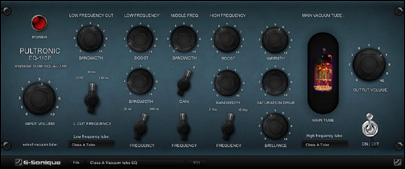
It has been over 17 years since we released our first tube plug-in, Pultronic. During that time we have done extensive research and experimentation, trying to create a tube simulation as faithful as possible to the original analog tubes — one that enhances the sound and does not add unpleasant digital harshness, but on the contrary softens the buzz, rounds off sharp digital transients and makes the sound more velvety.
How a vacuum tube works. A vacuum tube is an electronic component that was widely used in the early days of electronics to amplify and switch electrical signals. It consists of a closed glass or metal container holding several electrodes in a vacuum:
— Cathode: a heated filament or cathode electrode. When heated, it emits electrons through thermal emission, forming a cloud of negative charge around itself.
— Anode (plate): a positively charged electrode located near the cathode, which attracts the emitted electrons.
— Control grid: placed between cathode and anode, usually constructed of metal wires. Its voltage controls the flow of electrons from the cathode to the anode, and it is the main control element of the tube.
The positively charged anode attracts the emitted electrons, while the control grid — charged negatively or positively with respect to the cathode — changes the electric field between them, either attracting or repelling those electrons. The main function of the tube is amplification: by changing a small signal voltage on the control grid, the flow of electrons from cathode to anode is modulated. A small change of grid voltage can result in a much larger change of anode current, and that changing anode current is taken as the output signal of the tube.
Tubes generate heat due to the heated cathode, which limits their efficiency and reliability compared to modern semiconductors. Despite their drawbacks, tubes were essential components in early electronic devices — radios, televisions and computers — and paved the way for more advanced technologies. And of course, for a sound that producers still chase today.
Feature Highlights
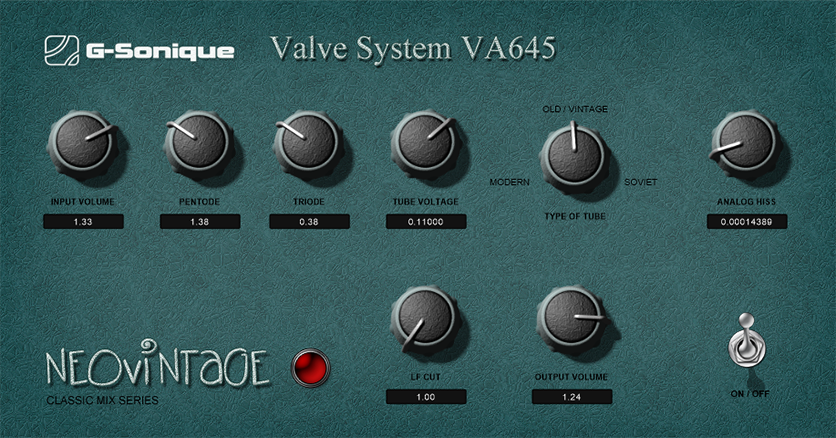
- Input volume knob — sets input level and at the same time the level of saturation, distortion, coloration and transient rounding
- Pentode knob — sets the behaviour of the vacuum tube
- Triode knob — sets the behaviour of the vacuum tube
- Tube voltage knob
- Tube type selector: modern, old vintage, soviet — each has a different sound and reacts differently to different input signals
- Analog hiss knob
- LP Cut
- Output volume knob
Demo Version
System Requirements
- Pentium III 1200 MHz / 256 MB RAM
- Windows XP/7/8/10
- VST/VSTi compliant host (Cubase, FL Studio, Ableton, Studio One, Sonar, Reaper)
Get your copy
- Instant delivery by email
- Secure PayPal / card checkout
- Trusted since 2007
- Used by pro artists worldwide
- VISA
- Eurocard / Mastercard
- American Express
- Diners Club
- Direct debit USA
- Bank / Wire transfer
- Cash deposit
- Switch / Solo, Check is also possible